
B2B Attribution: Measuring What Influences Revenue
.png)
A core challenge in B2B sales and marketing is identifying what drives a sale. Buyers interact with brands across multiple channels and touchpoints, often involving several stakeholders over time. This complexity makes it difficult to attribute a sale to a single factor.
Attribution connects marketing and sales activities to contacts, accounts, opportunities, and revenue. It identifies which activities contributed to outcomes and how much credit each deserves. In B2B, this is more complex than simply tracking lead sources, as buying journeys involve multiple people, channels, and extended timelines. Effective attribution must consider influence at both the contact and account levels.
For example, HubSpot distinguishes between contact creation, deal creation, and revenue attribution, enabling organisations to assess which interactions contributed at each funnel stage. This distinction is valuable because activities that generate awareness often differ from those that create opportunities or close deals.
The Main Attribution Models
No single attribution model is universally correct. Each addresses different questions and assumptions about value creation in the buying journey. Models are generally categorised as single-touch or multi-touch.
- First-touch attribution assigns all credit to the initial recorded interaction. This helps assess how prospects discover a business, especially for awareness and demand generation. However, it overlooks subsequent interactions, which can overstate the importance of acquisition channels in complex B2B sales cycles.
- Last-touch attribution assigns all credit to the final interaction before conversion. This highlights activities closest to the sale, but risks confusing proximity with causation. A final sales call may appear decisive, even though earlier efforts made that outcome possible.
- Linear attribution assigns equal credit to every recorded touchpoint. This approach recognises multiple interactions but assumes all are equally important, which is rarely accurate. For example, a generic page view and a strategic workshop do not carry the same commercial influence.
- Time-decay attribution gives more weight to recent interactions, assuming activities closer to conversion are more influential. Salesforce notes this is especially relevant in long B2B sales cycles. However, this model can undervalue earlier activities that created the opportunity.
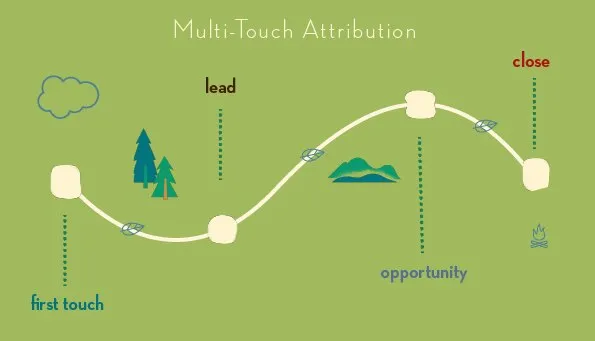
- U-shaped attribution emphasises the first interaction and lead creation, while W-shaped attribution also highlights opportunity creation. HubSpot and Salesforce use variations of these models to reflect key stages in the buying journey. These approaches are more effective than single-touch models because they recognise multiple critical conversion points.
- Full-path attribution includes activity through to the final close, recognising the combined contributions of marketing and sales throughout the journey. Custom-weighted models can also be developed for specific sales processes or industries, though increased customisation introduces more subjective judgment.
No attribution model provides an objective version of reality. Each is simply a framework for distributing credit across recorded interactions, and the most appropriate model depends on the business question being asked.
The Challenge is Connection
The mathematics of attribution is straightforward compared to the challenge of capturing underlying activity. Digital interactions are easier to record, as platforms like HubSpot and Salesforce can track clicks, page views, form submissions, email engagement, social interactions, and event registrations when systems are properly connected.
Sales activity is harder to capture, as calls, meetings, emails, and conversations only appear in attribution reports if they are recorded and linked to the relevant contact and deal. This creates a limitation, since key influences may occur outside formal systems.
A salesperson may meet a prospect informally and not log the interaction. Customers may refer colleagues, executives may make introductions, or prospects may engage with content anonymously. These interactions can significantly influence opportunities but remain invisible to attribution models.
The challenge increases when activity is spread across multiple platforms and tools. Effective attribution relies less on choosing the perfect model and more on ensuring data is complete, consistent, and connected.
Tools Matter, but Integration Matters More
Platforms like HubSpot and Salesforce offer advanced attribution capabilities, especially when marketing and sales activities are recorded in one environment. HubSpot can attribute interactions across various channels and analyse them against contacts, companies, deals, campaigns, and revenue.
From Attribution to Influence
This topic was discussed at our B2B Leaders Breakfast, From Attribution to Influence, on 26 August 2026, where the conversation shifted from technical mechanics to the organisational implications of measuring revenue contribution.
Traditional attribution often starts by asking who sourced the opportunity, reflecting an older division between sales and marketing. In reality, modern B2B buying is more complex, as marketing may create awareness and continue to influence opportunities after sales engagement.
A prospect in the pipeline may attend events, read content, respond to advertising, or speak with customers. These activities may not create the opportunity, but can influence its progression. Salesforce notes that multi-touch attribution increasingly measures marketing's influence on existing opportunities, not just lead origination.
This perspective is more useful for B2B attribution. Instead of focusing on which team deserves credit, it is better to ask which combination of interactions helped create, progress, and close the opportunity. This shifts the discussion from internal competition to understanding how marketing and sales work together.
Attribution is a Behavioural Problem
The discussion also highlighted that attribution is not just a technology issue but a behavioural one, as key parts of the B2B journey depend on people recording their activities.
Salespeople must log meetings, conversations, and relationship activities, while customers may need to explain how they discovered the organisation or what influenced their decision. Neither group is naturally motivated by attribution reports, so organisations cannot assume better data will result just because the CRM has the required fields.
Gamification and incentives can help address this challenge. Sales teams can be rewarded for maintaining complete records, CRM hygiene can be tied to performance, and customers can be encouraged to provide feedback through incentives or streamlined processes. Organisations should design for desired behaviours rather than treating data completeness as a compliance issue.
Attribution is Not Causation
There is a risk in viewing attribution as more precise than it is. A model may assign specific revenue percentages to interactions, but this apparent precision should not be mistaken for certainty about causation.
Attribution does not prove causality. It allocates credit according to a defined set of rules across the interactions that were recorded. This does not make attribution useless, but it does mean that it should be treated as a decision-support tool rather than an accounting system.
The purpose is not to prove that one campaign caused a particular sale. The goal is not to prove that they caused a sale, but to identify patterns in successful customer journeys and use them to inform investment, channel mix, and sales activity decisions. Attribution tends to focus on allocating credit, while influence focuses on understanding which activities appear to have helped an opportunity progress.
In complex B2B environments, influence is often the more useful managerial focus, as buying decisions rarely result from a single channel or interaction. The aim is to gain enough visibility into the customer journey to inform future decisions.
Achieving this requires technology, integration, and a practical attribution model, as well as teams that understand the importance of data and systems that simplify data capture. The main challenge lies in organisational behaviour and data quality, not in attribution mathematics.
How Human Digital Helps B2B Brands with Attribution
At Human Digital, we help B2B organisations design practical, commercially relevant attribution approaches aligned with actual buying behaviours. We begin by defining key business questions, identifying important customer journey stages, and selecting an attribution model that fits the organisation's sales cycle, channels, and decision-making process.
We then design the data and measurement framework to support the chosen model. This includes contact and account structures, opportunity and revenue linkage, campaign architecture, UTM governance, CRM requirements, channel tracking, and integration with platforms such as HubSpot, Salesforce, analytics tools, and advertising systems. Operations teams to implement the model, improve data capture, develop reporting and dashboards, and establish the processes required to maintain attribution over time. Where human behaviour affects data quality, we also consider how workflows, incentives and internal adoption can improve the completeness and reliability of the information being collected.
The objective is not to create an attribution model that looks impressive in a dashboard. It is to create a measurement system that helps B2B leaders make better decisions about marketing investment, sales activity and the combination of interactions that influence revenue.
If you want to improve how your organisation measures the influence of marketing and sales on revenue, get in touch to arrange a free consultation.
Read more
https://www.salesforce.com/blog/what-is-marketing-attribution-model/
Recent insights

.png)



.png)