
The CMO's New Mandate: Commercial Credibility, Customer Obsession, and the AI Opportunity
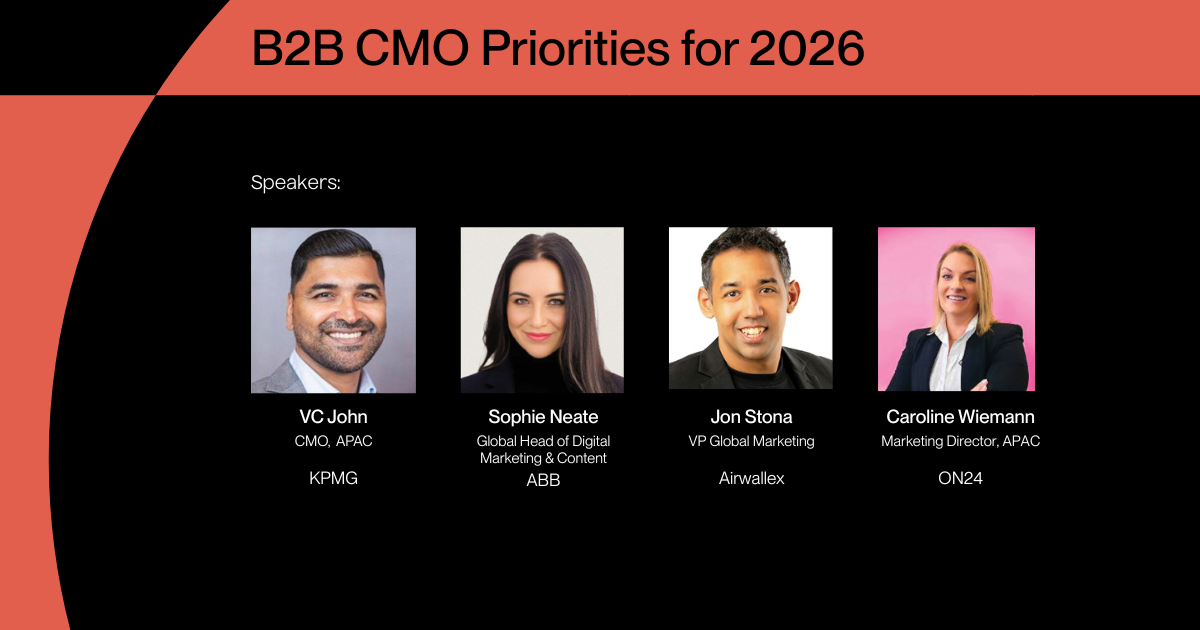
Key insights from the B2B CMO Priorities for 2026 webinar, featuring VC John (CMO APAC, KPMG), Sophie Neate (Global Head of Digital Marketing & Content, ABB), Jon Stona (VP Global Marketing, Airwallex), and hosted by Caroline Wiemann (Marketing Director APAC, ON24).
Yesterday I joined some of the sharpest marketing minds in B2B for a candid, often provocative conversation about what it really takes to lead marketing in 2026. The headline? The CMO role has fundamentally changed. And the marketers who are thriving are the ones who have stopped hiding behind the metrics of yesterday and started speaking the language of the boardroom.
What struck me most across the 55-minute session wasn't any single insight. It was the coherence of perspective across very different organisations: a Big Four professional services firm, a global industrial technology giant, and a fast-growing FinTech challenger. They're all grappling with the same challenge: how do you prove that marketing drives the business, not just the brand?
1. The CMO Is Now a Commercial Driver. Full Stop.
The data shared on the call was stark. According to McKinsey, CEO-CMO disconnect has increased by around 20% between 2023 and 2025. More telling still: 69% of CMOs now report that their CEO and CFO no longer believe in the long-term value of brand building, a significant drop from 80% the year prior.
That's a crisis signal. And the response from the panellists was unanimous: CMOs must step up as commercial operators, not brand custodians.
VC John from KPMG articulated this brilliantly. He described the modern CMO's role as being the firm's "headlights", translating market intelligence and pipeline data into actionable insight that the entire business can use. "Traditionally, CMOs would cringe at that idea," he said. "But I don't think it's an option anymore."
Jon Stona from Airwallex offered a sharp mental model: imagine you're on the earnings call. Your CFO isn't talking about MQLs and SQLs. They're talking about net customer additions, gross profit, and revenue. As a marketing leader, your job is to translate what you do into those terms, or risk becoming irrelevant becoming irrelevant to the conversation that actually matters.
Sophie Neate from ABB made this tangible. At ABB, marketing contributed $72 million USD to pipeline in the last financial year, delivering a 69% return on investment. That kind of number doesn't just get you a seat at the table. It gets you a bigger budget.
"The stronger you're able to present your business case effectively, the more money you'll get, and the more impact you will create."
2. Brand and Performance Are Not a Trade-Off. They're a System.
One of the most important reframes of the session came from Jon Stona. He pushed back hard on the idea that brand investment and performance marketing are in tension. "We don't see them as trade-offs. We see them as having to work in a very complementary manner."
His framework: marketing serves two purposes: driving the brand (awareness, consideration, equity) and driving the business (revenue, retention, growth). These reinforce each other. The stronger your brand, the more efficiently your performance spend works. The more customers you acquire, the more brand prominence you build. It's a flywheel, not a fork in the road.
For Airwallex, this means watching lower funnel performance carefully. When demand capture starts to hit diminishing returns, that's the signal that top-of-funnel brand investment is needed. The brand work isn't a luxury. It's the fuel that makes everything else run.
Sophie Neate gave us the numbers behind this philosophy. ABB allocates at least 60% of their marketing budget to brand, and 40% to lead generation and conversion. For a company operating in over 100 countries with average sales cycles of nine to twelve months, that ratio isn't idealistic. It's strategic.
Jon also made a point that resonated deeply with me from a Human Digital perspective. He talked about the value of sports sponsorships in building trust, not because you can perfectly model the ROI upfront, but because common sense and conviction told them it was right. "Data should never replace common sense," he said. "Sometimes we're hamstrung by endless analysis. We need to be bold."
Meeting your audience through a cultural avenue they already have affinity towards, whether that is sport, community, or shared values, builds the trust that makes all your performance marketing work harder. It's not B2C logic bleeding into B2B. It's just smart marketing.
3. Retention Is the Growth Strategy Most B2B Brands Are Under-Investing In
Every panellist pointed to customer retention not as an afterthought but as the core of their growth strategy. The cost of acquisition is rising. Budgets are under pressure. And for ABB, the biggest growth opportunity isn't in the net new. It is in the installed base.
Sophie described a sophisticated nurturing architecture that segments customers by stage: pre-sales prospects who need brand warming, active customers who need value reinforcement, and post-sales accounts primed for upsell and cross-sell. AI is the engine that makes this personalisation possible at scale across 100+ markets.
For KPMG, VC John described a governing council model where every priority account is assigned market development funds, and every touchpoint is tagged back to an opportunity ID that stays with the customer for life. Marketing isn't executing campaigns. It's managing the long-term commercial relationship.
Airwallex went further, spinning customer marketing out of the marketing function entirely into a cross-functional growth pod that includes data science, engineering, sales, product, and marketing. The logic is simple: everyone needs accountability for customer outcomes. When you house retention solely in marketing, the dependencies and misaligned priorities cause things to fall apart.
4. MQLs Are Dead. Long Live Marketing Qualified Accounts.
Sophie Neate said it plainly: "Marketing qualified leads are dead." In B2B, the buying decision involves a committee. The idea that a single lead represents a sales opportunity has always been a convenient fiction. What actually matters is account-level engagement and intent signals: understanding which buying group members are in-market, what they're researching, and how to orchestrate content to move the whole account forward.
VC John echoed this, describing how KPMG's marketing function is focused on understanding the quality of client relationship mapping across target accounts, then identifying the white space where investment in specific offerings will create land-and-expand opportunities. It's a fundamentally different way of thinking about pipeline.
5. AI Is the Amplifier, But Authenticity Is Still the Asset
The AI conversation was the richest part of the webinar, and also the most nuanced. Every panellist is investing heavily in AI, but their framing was consistently one of amplification, not replacement.
Sophie shared ABB's internal AI tool called Abby (powered by Claude), which translates content into multiple languages, produces videos with multilingual voiceovers and employee avatars, and scales personalised campaign content across their global operations. Crucially, Abby handles the operational tasks so the team can focus on strategic ones.
Jon Stona's vision for AI was even more ambitious: a unified agentic workflow where synthetic research, creative brainstorming, ad production, and performance analysis exist in one connected loop. Right now everything is still siloed. When that unification happens, it will be genuinely transformational.
But VC John offered the most important reframe on thought leadership in the age of AI. The idea that AI will make thought leadership easier, he argued, is antithetical to what thought leadership actually is. Thought is provocative, surprising, and inspiring. It sets up what the market should be excited about. You cannot outsource that to a language model. The thought still has to come from a human with their finger on the pulse.
Jon added the paradox clearly: AI has lowered the barrier to content creation so dramatically that we're now drowning in low-quality content. The brands that will cut through are the ones creating genuine value, not volume. AI makes you more efficient. Product marketing gives you the message worth scaling.
6. The SEO Playbook Has Been Rewritten. Have You Updated Yours?
Jon Stona made a point that every B2B marketer needs to hear: the traditional SEO playbook is obsolete. Obsessing over website traffic as a primary metric is no longer relevant. Your buyers are researching on Reddit, YouTube, and through AI-powered search tools like ChatGPT, Perplexity, and Google AI Overviews. If you're not visible in those environments, you're not visible.
Sophie shared ABB's tactical response to this reality. They've stopped gating content entirely, because buyers arrive at your website having already done 80% of their research. Putting your best content behind a form just creates friction at the wrong moment. Instead, they're ensuring every page has FAQ schema markup, because AI models pull from structured FAQ content. They're bullet-pointing key value propositions where appropriate. And they're showing up on Reddit with authentic, engineer-led AMA campaigns rather than branded sales pitches.
This is Answer Engine Optimisation, and it's the next frontier for B2B content strategy.
The Takeaways That Stuck With Me
Across an hour of incredibly dense, honest conversation, a few things crystallised for me.
Speak the language of revenue, not marketing. If your metrics wouldn't survive an earnings call, they won't survive budget season either. The CMOs winning in 2026 are the ones who can translate marketing activities into pipeline, profit, and growth.
Brand and performance are a system, not a choice. The moment you treat them as trade-offs, you've already lost. The strongest marketing organisations run them in sync, with clear visibility into how brand investment is making performance spend more efficient.
Your installed base is your biggest growth lever. The cost of acquisition will keep rising. The brands that win long-term are the ones investing in retention, lifecycle value, and the cross-functional infrastructure to support it.
AI amplifies. It doesn't replace. Use it to scale what works, but the thought, the strategy, and the authentic human perspective still have to come from you.
Ungate your content. Give buyers what they need to make the decision. If you're one of the three brands they already have in mind when the buying cycle starts, you'll win. If you're gating your way to obscurity, someone else will.
At Human Digital, we work with some of the world's most ambitious B2B brands to bridge exactly the gap this panel described: bridging the gap that builds trust and the demand engine that drives revenue. If these themes are live in your organisation right now, I'd genuinely enjoy the conversation.
Ben van Rooy is founder of Human Digital and Alex & Sloane, and co-host of Canned: The Marketing Podcast.
Recent insights







.png)
