LinkedIn for SEO

For B2B marketing teams in New Zealand and Australia, LinkedIn has quietly stopped being a social feed and started being a publishing channel. Used well, it turns your expertise into content that ranks in Google, gets cited by AI answer engines like Perplexity and Gemini, and shapes a buyer's shortlist long before they are ready to talk to sales. The catch is simple: this only works when you treat LinkedIn articles and newsletters as searchable web pages, not disposable posts.
Key Takeaways
- LinkedIn articles and newsletters get their own crawlable URLs and are usually indexed by Google within 24 to 48 hours. Standard feed posts generally are not.
- 73% of B2B decision-makers say thought leadership is a more trustworthy way to judge a company's capability than its marketing materials and product sheets. (Edelman and LinkedIn, 2024)
- 86% say consistent, high-quality thought leadership makes them more likely to invite a company into the RFP process. (Edelman and LinkedIn, 2024)
- At any given moment, roughly 95% of your buyers are not in-market. Thought leadership is how you stay on their shortlist until they are. (Ehrenberg-Bass, the 95:5 rule)
- The real win is a content system where one idea works across LinkedIn, search, and AI answers, not a post that disappears in 48 hours.
Is LinkedIn good for B2B SEO?
Yes, but only for the right formats. LinkedIn articles and newsletters are indexable web pages. Standard feed posts mostly are not.
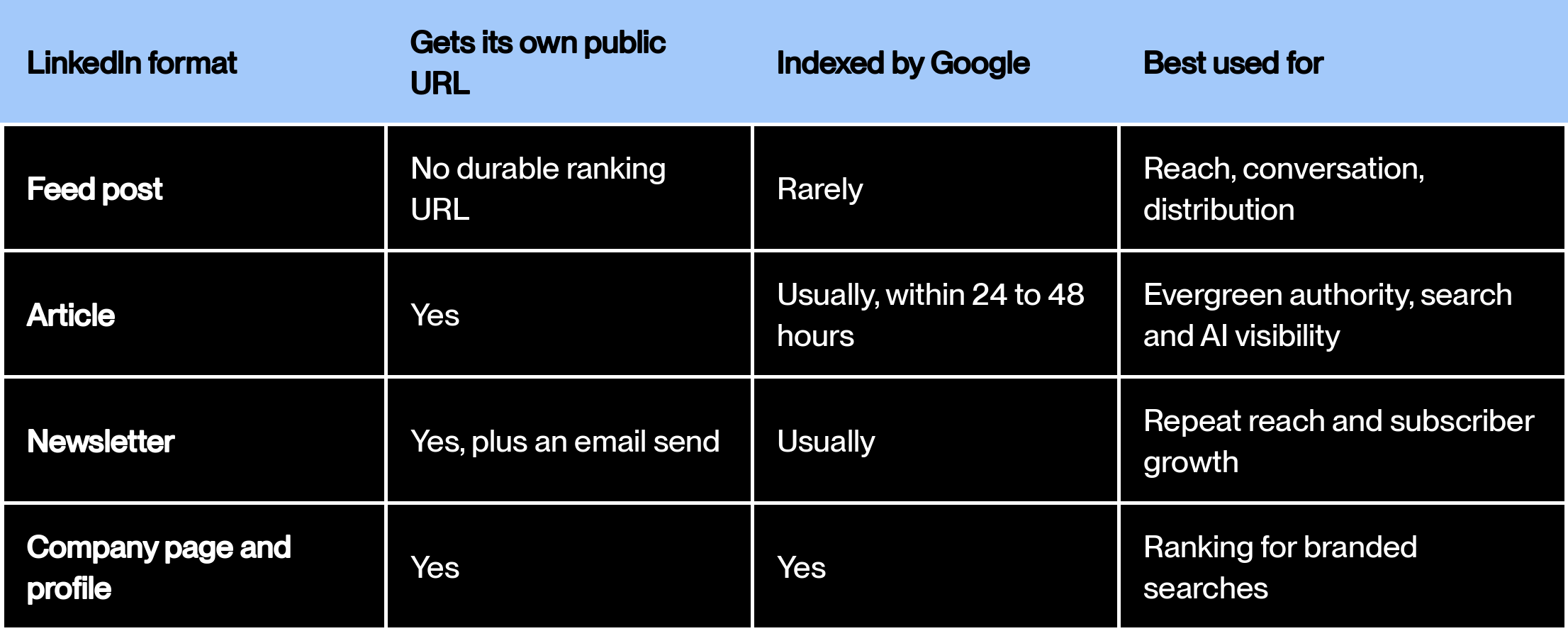
When you publish a LinkedIn article or newsletter, it is given its own public URL that Google can crawl and rank, usually within 24 to 48 hours. Standard feed posts rarely earn that kind of durable, searchable presence, because much of that content sits behind sign-in walls or is excluded from indexing. Your company page and personal profile are also crawlable, which is why they often rank for searches of your brand name.
Why does LinkedIn visibility matter now? Because 95% of buyers are not ready yet
At any given time, around 95% of B2B buyers are not actively looking to buy (Ehrenberg-Bass Institute). That means most of your future pipeline is sitting out-of-market, forming opinions and quietly building a shortlist in their heads.
When those buyers do start researching, they begin where everyone begins. In the 2024 B2B Buyer Survey, web search (66%) and vendor websites (45%) were the first two resources buyers turned to (Demand Gen Report, 2024). Being discoverable in search and visibly useful on LinkedIn means you are already in the conversation when the research starts, rather than scrambling to enter it.
How does thought leadership influence the B2B shortlist?
Strong thought leadership does not just build awareness. It changes who buyers trust and who they invite to the table. The 2024 Edelman and LinkedIn B2B Thought Leadership Impact Report is unusually clear on this, and the numbers are worth quoting directly.
- 73% of decision-makers say an organisation's thought leadership is a more trustworthy basis for judging its capability than its marketing materials and product sheets.
- 9 in 10 (90%) are more receptive to sales or marketing outreach from a company that consistently produces high-quality thought leadership.
- 86% are more likely to invite that company into the RFP process.
- 60% say good thought leadership makes them willing to pay a premium to work with that organisation.
- 52% of decision-makers and 54% of C-suite executives spend an hour or more every week reading thought leadership.
Read together, these point to one conclusion: thought leadership is where the shortlist is built, and a premium is justified. This is the mindshare that Human Digital's LinkedIn thought leadership work is designed to earn for B2B leaders.
Posts, articles, or newsletters: what should B2B teams actually publish?
The problem is rarely too little LinkedIn content. It is too much content with no long-term job. Here is how to give each format a clear role.
- Publish your cornerstone ideas as LinkedIn articles, not posts. Articles earn an indexable URL, so search engines and AI can find them long after the feed forgets them.
- Turn your best-performing blog into a LinkedIn newsletter. It gets its own URL and lands directly in subscriber inboxes, which compounds reach over time.
- Engineer the first two lines of every post as the hook. That is all a reader sees above the see-more fold, so it decides whether the rest gets read.
- Give every piece one job: distribution and conversation (posts), evergreen authority (articles), or repeat reach (newsletters).
- Repurpose one strong idea across all three formats instead of chasing daily volume. Depth on a few ideas beats a high tempo of forgettable ones.
How do you make LinkedIn content AI-citable?
AI answer engines build their responses from clear, well-structured, publicly accessible content. LinkedIn articles qualify. Ephemeral feed posts usually do not. If you want ChatGPT, Perplexity, or Gemini to reference your expertise, the format and the structure matter as much as the idea.
- Write answer-first. Open each piece by stating the answer plainly, then explain it. Engines lift the clean answer, not the windup.
- Use plain, question-shaped headings and make every section stand on its own, so a crawler can extract it without the rest of the page.
- Be consistent and specific. Models surface brands that appear repeatedly across credible sources with a clear, recognisable point of view.
This is the same standard Human Digital applies to AEO and answer-engine optimisation for its clients, because the brands that get cited are the ones that make themselves easy to quote.
HD Insight. Across our work with B2B brands in New Zealand and Australia, the pattern repeats: the teams that win out-of-market mindshare treat a small set of LinkedIn articles as cornerstone assets they update and re-share, rather than publishing dozens of posts that vanish in two days. We have seen the same compounding play out in our content work: NZ Pump's ongoing SEO and AEO programme lifted sessions 50% and engagement 66% in two months, the payoff of treating a few well-structured assets as cornerstones rather than chasing volume.
FAQ's
Do LinkedIn posts help SEO?
Standard feed posts have limited direct SEO value, because they rarely earn a durable, indexable URL. LinkedIn articles and newsletters do, and they are usually indexed by Google within 24 to 48 hours.
Do LinkedIn articles get indexed by Google?
Yes. Each LinkedIn article is published at its own URL that Google can crawl and rank, typically within a day or two of publishing.
Is LinkedIn good for B2B lead generation?
It is, because most B2B buyers are out-of-market and researching quietly. Consistent thought leadership keeps you on the shortlist, with 86% of decision-makers saying it makes them more likely to invite a company into the RFP (Edelman and LinkedIn, 2024).
How often should a B2B brand publish on LinkedIn?
Consistency beats volume. A steady rhythm of cornerstone articles, supported by posts that distribute them, outperforms daily posting with no long-term role.
Does LinkedIn content show up in AI search like Perplexity or Gemini?
It can. Public, well-structured LinkedIn articles are the kind of content AI answer engines retrieve and cite, while sign-in-walled or ephemeral posts are far less likely to be surfaced.
Turn your LinkedIn presence into a real search asset
Most B2B teams have no idea which of their LinkedIn articles are actually indexed, where they rank, or whether AI answer engines reference them at all. That is the first thing we look at. Human Digital maps which of your articles are indexed, where they sit in search, and how your expertise shows up in AI answers, then shows you the gaps worth closing.
Talk to a human at Human Digital.
Human Digital. Where funnels meet fingerprints. B2B digital marketing, by humans, for humans.
Sources
- Edelman and LinkedIn, 2024 B2B Thought Leadership Impact Report
- Demand Gen Report, 2024 B2B Buyer Survey
- Ehrenberg-Bass Institute, the 95:5 rule (via the LinkedIn B2B Institute)
Recent insights



.png)