
Beyond AI Adoption: Choosing the Right Problems to Solve
.png)
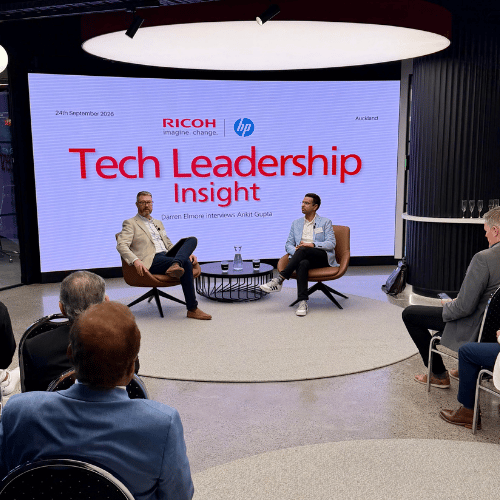
As AI becomes more accessible, the technology itself offers less differentiation. Advantage increasingly comes from the problems an organisation chooses to address and its ability to solve them well. That requires the knowledge, discipline and organisational capability to turn technology into better decisions and outcomes. This was a key theme at Ricoh New Zealand’s From Data to Decisions event in Auckland, featuring Ankit Gupta from The Warehouse Group and Darren Elmore from Ricoh New Zealand.
Access to AI is now table stakes
The commercial value of technology should not be mistaken for strategic distinctiveness. As AI models, embedded assistants, and automation tools become widely available, access alone is unlikely to provide a lasting advantage.
Ankit observed that many organisations rely on the same major platforms and models. Differentiation now depends more on organisational knowledge, context, and processes. We have seen this before with cloud computing, CRM systems, and marketing automation. They all generated value, but their advantage diminished as adoption became widespread.
AI is following a similar trajectory. When competitors possess comparable technology, advantage depends on its application, the significance of the problems addressed, the quality of available information, and the organisation’s ability to act on insights.
We routinely underuse the technology we already have
Organisations frequently invest in technology without implementing the behavioural changes required to realise its value. CRM systems may be poorly maintained, analytics platforms can generate additional reports without improving decisions, and marketing automation tools are sometimes used for tasks that simpler systems could address.
Ankit compared this to purchasing a gym membership, where just having a membership does not create results. Similarly, providing access to an AI platform does not ensure productivity, innovation, or improved customer outcomes. Value is realised when work habits and decision-making processes are transformed.
His insight is that organisations need to move from reactive to proactive decision-making. Reactive organisations begin with the available data and ask what can be demonstrated, while proactive organisations start with the decision to be made and work backwards to identify the information required. The shift is significant because it moves the focus away from technology itself and towards organisational purpose, judgement and action.
Problem selection matters more than solution selection
AI has significantly expanded the range of possible solutions, creating a temptation to begin with technology and subsequently seek applications. This approach can result in solution-led innovation, where organisations search for problems to justify tools they already possess.
During the discussion, I asked Darren how Ricoh ensures clients remain focused on the problem rather than applying AI indiscriminately. He explained that organisations should first identify problems that can generate meaningful value, then select the appropriate technology. Innovation should also be integrated into core business activities rather than treated as a separate function.
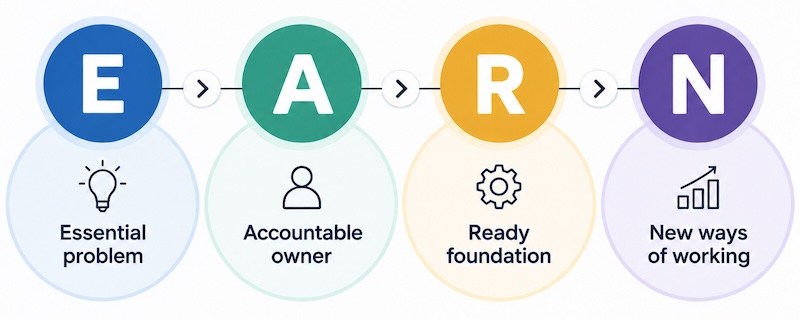
Ankit talked about the EARN framework. The framework begins with an essential problem: assigning an accountable owner, establishing a solid foundation, and adopting new ways of working. The sequence is critical because a solution’s value is constrained by the significance of the problem it addresses.
A functioning agent or automation proves the technology works, not that the problem was worth solving. The real question is whether automation creates meaningful value.
Foundations matter
Another key theme was the organisational foundation required to use data and AI effectively. An increase in data does not guarantee improved decisions. Organisations may have extensive reporting yet still lack consensus on definitions, ownership, and the interpretation of key measures.
Different teams may bring different, technically correct numbers to the same meeting. The problem is not a lack of data, but a lack of shared definitions. AI does not resolve this issue. Instead, it underscores the importance of organisational context, as the usefulness of AI outputs depends on the quality and relevance of the information provided.
Every organisation has accumulated knowledge about its customers, processes and past decisions. As AI models become more interchangeable, this institutional knowledge becomes more valuable because the technology can be replaced far more easily than the context that makes it useful.
AI adoption is an organisational challenge
AI adoption is not solely a matter of technical competence. Ankit emphasised the importance of habits and behaviours, particularly among leaders, arguing that organisations must change how people approach work and decisions, rather than simply training them to use new tools.
This helps explain why technology investments often fail to deliver expected value. Technical deployment can be rapid, but organisational change requires clear ownership, new management practices, redesigned processes, and a willingness to discontinue activities that no longer add value.
Accountability is also essential. While AI can support decisions or generate outputs, responsibility for their use remains with the organisation and its members.
Strategy is changing
As AI becomes more accessible, strategic intent matters more. Organisations need to be clear about which problems they are solving, what success looks like and how new capabilities will be embedded into the way they work.
The same applies to expertise with information and technology being more widely available, but judgment, context and the ability to decide what to do remain harder to replicate.
For organisations considering further AI investment, the starting point should always be the problem. Once the problem, ownership, desired outcome and measures of success are clear, the technology decision becomes much easier.
How do you decide what problems to prioritise?
Human Digital assists organisations to define the customer or business problem and working backwards to identify the appropriate solution. We integrate strategy, data, technology, and process to determine where genuine value can be created and how to deliver it effectively. AI may form part of the solution, but the objective is not AI adoption for its own sake. The goal is to achieve better decisions, improved customer experiences, and enhanced commercial outcomes.
Recent insights

.png)



.png)