Is out-of-home advertising effective for B2B marketing?
.png)
Connecting with B2B buyers requires looking beyond the moments when they are searching for a supplier. Out-of-home (OOH) offers a way to connect a brand with the physical environments in which its audience works and travels.
While not every billboard should or will generate a sales enquiry, the art of a good out-of-home campaign combines broader visibility and awareness with an informed understanding of where the target audience is physically located and when it is likely to encounter the message. An airport lounge, an office lift and a freeway approaching a trade retailer can all be relevant B2B environments, but for different audiences and reasons.
Awareness matters before the buying process begins
One of the ongoing problems in B2B marketing is that too much investment is directed towards people who are already in market. Research by Professor John Dawes for LinkedIn’s B2B Institute, and James Hurman in his 2026 book Future Demand, makes the case that marketing needs to serve both today’s customers and tomorrow’s customers.
Performance marketing, including lead-generation campaigns, helps capture existing demand, while brand building and awareness create the familiarity and mental availability required to compete for future demand as buyers enter the market. Broader brand awareness is the basis for reviewing out-of-home in B2B by establishing brand recognition, increasing the likelihood it comes to mind when that problem becomes a commercial priority.
Using research to determine location and timing
A strong out-of-home brief should begin with buyer behaviour; understanding where the target audience is likely to be physically and when they are most likely to encounter the message. Customer interviews, sales team knowledge, office tenant information, travel patterns, and media owner audience data can all help build that picture.
Useful research questions should include:
- Where do they work?
- Which routes do they travel?
- Where do they meet customers?
- Which conferences and events do they attend?
- Where do they purchase supplies?
Location then needs to be considered alongside timing. A relevant building may attract different audiences on different days, while a roadside placement may perform very differently depending on the direction of travel (e.g., morning and evening rush hours). If digital inventory supports scheduling, the time of day should also reflect actual audience behaviour rather than a generic assumption about the working day.
Airports are worth investigating when the target audience includes frequent business travellers, particularly where relevant routes connect commercial centres or major industry events. Lounges deliver a more concentrated environment within that larger audience. For example, oOh!media’s Qantas lounge network is positioned around frequent flyers, business leaders and decision-makers, with screens appearing alongside flight information and news.
Corporate lobbies and lifts offer a different advantage: repeated exposure within the work environment. Their relevance can be assessed in part by the organisations occupying a building. In Australia, oOh!media offers office-network planning using tenant data, such as industry and business size, enabling location planning to move beyond postcode-level assumptions.
A newer addition is advertising delivered through hotel-room televisions and lobby screens, with The Travel Network announcing its in-room hotel advertising platform in April 2026. For B2B marketers, this creates another possible touchpoint across a business trip, extending visibility from the airport to the hotel and the surrounding commercial environment.
Messaging choice and integration
An out-of-home campaign should have a clearly defined communication task. For a less familiar business, that may be building its name and category. For an established supplier, it may be strengthening an association with a particular problem or introducing a new proposition. In either case, the creative brief should prioritise what someone needs to remember, rather than attempting to reproduce a website or sales presentation.
Messaging should connect with the customer experience,, considering search, social, website, events, and sales conversations, to make it easy to recognise the same business and comprehend its offer. Zoho’s account is instructive because the sense of seeing the brand “everywhere” came from several coordinated activities, not outdoor media alone.
For campaign planning, this means considering what happens after exposure, even when an immediate response is not expected. A person who later searches for the brand should encounter a clear proposition and credible evidence, while the sales team should understand the campaign and record relevant customer feedback. Awareness is more useful when the organisation is prepared to turn recognition into a meaningful conversation.
Size and placement matters
The effectiveness of out-of-home depends not only on where the advertising appears, but on the size of the format and how the creative is treated for that environment. A large roadside billboard viewed at speed has a very different job from a screen in an airport lounge, an office lift or a hotel room.
A person moving through an airport terminal may have only a few seconds to register a message, which places a premium on scale, simplicity and immediate brand recognition. Someone sitting in a lounge or hotel room may have considerably more time, permitting a more detailed proposition. Lift advertising sits somewhere else again, with short but potentially repeated exposures over days or weeks.
Creative should be designed for the context in which it will be seen, rather than simply resizing the same advertisement across several screens. The amount of information, type size, visual hierarchy and complexity of the message should reflect viewing distance, dwell time and frequency of exposure.
How to measure out-of-home for B2B effectiveness
Measuring out-of-home in B2B requires the same discipline as broader attribution. The objective is not to force every exposure into a neat revenue calculation, but to understand how the channel contributes to awareness, consideration and commercial outcomes over time.
An integrated measurement plan should distinguish between media delivery, changes in awareness and downstream business impact.
- Reach, frequency and delivery data tell you whether the campaign was seen at the intended scale.
- Brand research, branded search, direct traffic and customer-reported exposure can help indicate whether awareness and recall changed.
- Commercial measures such as enquiries, target-account engagement, opportunities and pipeline can then be reviewed over a longer period.
Comparisons between exposed and similar unexposed markets can strengthen the analysis. Sales teams should record when customers mention seeing outdoor activity, as these qualitative signals can help explain the influence that digital tracking often misses.
Zoho: building familiarity through a visible market visibility
Zoho’s experience provides a useful example of how out-of-home can contribute to B2B awareness. In 2026, Zoho used buses, airport advertising, digital screens in co-working and office buildings, and digital billboards in Auckland. Its Sydney activity includes tram wraps, airports, office screens and digital billboards.
Zoho’s outdoor placements have operated alongside other marketing activities. In New Zealand, outdoor activity began around the same time as digital advertising across social media, display, and YouTube, with a regular presence at business events. Zoho reports that customers noticed the brand appearing in several places, saying: “We keep seeing Zoho everywhere so we thought we’d see if it’ll work for us.” The immediate association was obvious: Zoho meant business software. That is a useful notice that an awareness campaign need not communicate the entire product proposition to play a valuable role.
Zoho also reports that outdoor visibility helped ready-to-buy prospects add the company to their consideration set or feel reassured about considering it. Some subsequently became customers. Its account describes benefits beyond acquisition, including enthusiasm from existing customers, interest from potential implementation partners and a perception among some enterprise prospects that Zoho was a more established and financially stable option. These are reported experiences rather than independently isolated effects, but they illustrate the different ways that visibility can contribute to commercial relationships.
This is a great example of an integrated B2B marketing strategy with outdoor advertising, digital media, events and sales conversations reinforcing each other. Zoho’s experience supports the case for making a brand more familiar across the customer’s environment, rather than attributing every subsequent enquiry to a billboard.
OMO Professional: reaching tradies before the Bunnings run
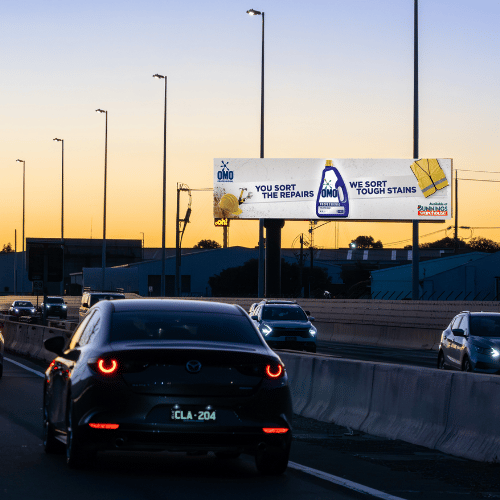
OMO Professional needed visibility among tradies, so Human Digital worked with Unilever Professional to concentrate digital out-of-home activity across Melbourne’s West Gate Freeway and surrounding routes, selecting sites near priority Bunnings warehouses. The creative, “You Sort The Repairs, We Sort The Tough Stains,” was designed for a short freeway read, with a clear trade-relevant message, prominent product imagery and Bunnings availability.
The campaign generated more than 5.13 million audience contacts, reaching around 30% of Melbourne’s adult population at an average frequency of 3.65. During the period when OOH was fully in market, OMO Professional Search also gained strength. From March–April to May–June, clicks increased by around 12%, and recorded conversions increased by 19%.
While these results do not prove that OOH caused the improvement in digital performance, they illustrate how channels can work together: OOH building physical visibility in relevant locations, display and Meta extending awareness digitally, and Search capturing demand when buyers were ready to investigate or act.
How Human Digital can help
Human Digital helps B2B brands connect audience understanding, media strategy, creative development and campaign execution. Our Unilever Professional work illustrates how that can translate into deliberate site selection, context-specific messaging and delivery reporting. To discuss where out-of-home may contribute to your B2B marketing strategy, get in touch with Human Digital.
Recent insights



.png)